Where to Play
Best Golf Courses in Northwest Indiana
Public golf across the state line on Chicago time, plus three members-only clubs
Updated · November 15, 2026
Northwest Indiana starts at the Illinois state line, and it keeps Chicago's clock: Lake, Porter, LaPorte and Jasper counties, home to the courses below, sit in the Central time zone, while most of Indiana runs on Eastern. For a small region the public golf is varied, from a 1930s city course to a Michael Hurdzan design, a course capped over a steel-mill slag dump and a sand-and-pine layout far enough out to justify an overnight. This guide is for Chicago golfers willing to cross the state line and for visitors staying on the Indiana side; every listing sits in the Northwest Indiana region.
How far you drive depends on the course. By the clubs' own estimates, Lost Marsh in Hammond is about 30 minutes from downtown Chicago, White Hawk in Crown Point less than an hour and The Course at Aberdeen in Valparaiso about an hour, while Golf Chicago Magazine put Sandy Pines in DeMotte about 90 minutes from O'Hare.
The public courses
The Course at Aberdeen, Valparaiso
Aberdeen is the region's name-brand public design. Michael Hurdzan built it in 1997, nine years before Erin Hills, his co-design with Dana Fry and Ron Whitten, opened in Wisconsin. It runs through a residential community, among tree-lined fairways, preserved wetlands and rolling ground, and OGM manages it with daily public tee times alongside annual passes. The card is unusually even: each nine has two par 3s and two par 5s, and from the Black tees the nines differ by just 29 yards. At 6,925 yards and 73.3/138 it is a proper test without being a slog, and its hardest holes by handicap are two long par 4s, the 436-yard 3rd and the 435-yard 16th.
Sandy Pines, DeMotte
Sandy Pines is the surprise. The ground is sand under mature white pines, with a ridge running the length of the course whose white-tinted sand co-owner Mitch Van Kley traces to a time when Lake Michigan's shoreline reached this far, and the owners compare the setting to the Carolinas. William J. Spear's 1973 course got a major overhaul from Tim Nugent in 2004, which added ponds, bunkers and bentgrass tees and fairways. Golf Chicago Magazine found the par 4s gettable and the long par 3s and par 5s the real test, and the card bears that out: four par 5s of 549 yards or more and par 3s up to 249, for 6,801 yards and 73.4/136 from the back tees. On-site cottages make it a workable overnight, which at this distance from the city is worth considering.
Lost Marsh, Hammond
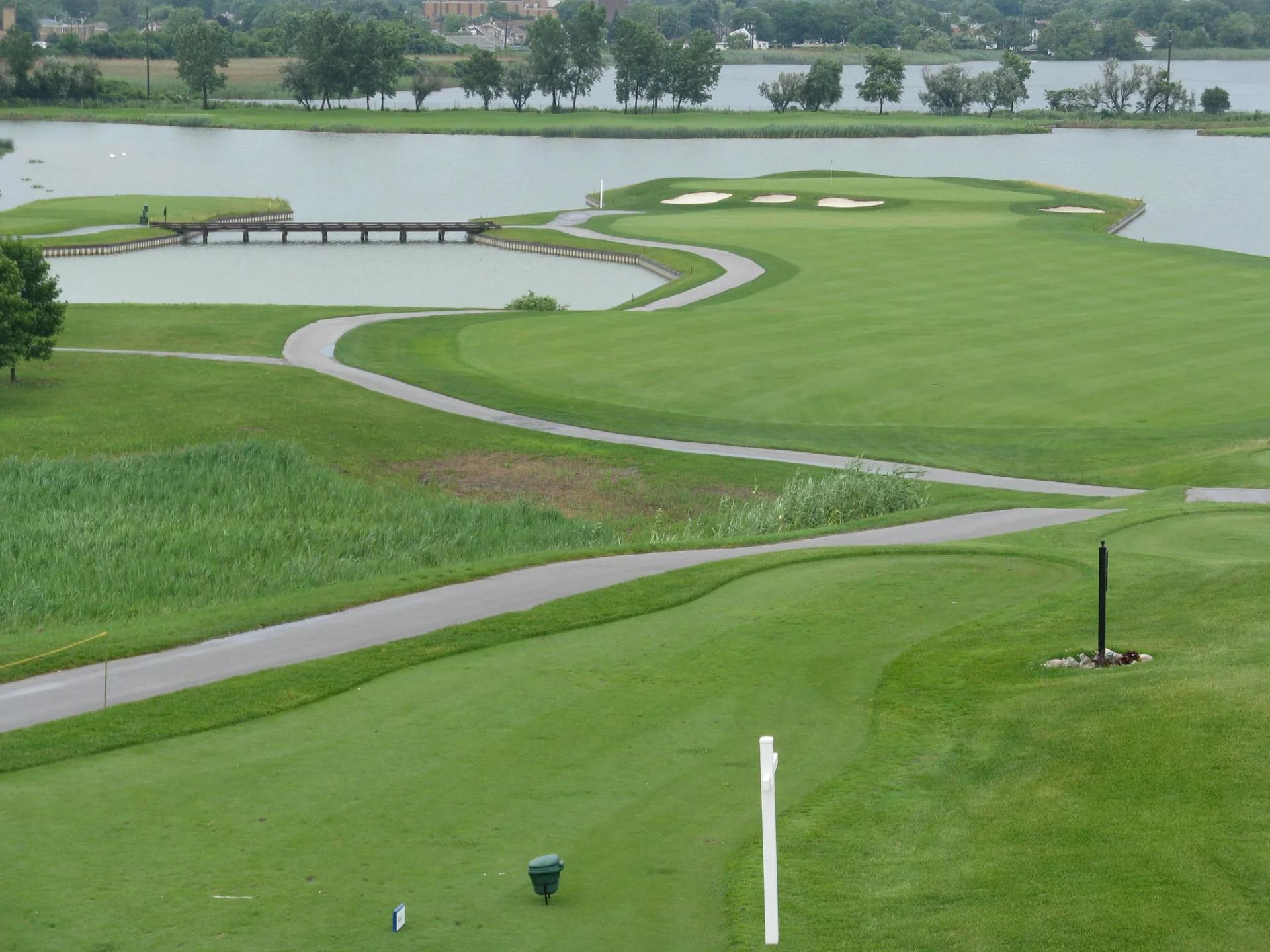
Lost Marsh has the best backstory in the region. The City of Hammond bought the old Bairstow slag dump in 1998 and capped it with a Charles Howard course that opened in September 2003; EPA officials, in a Chicago Tribune report cited by Audubon International, called it the Midwest's largest and most successful brownfield reclamation. Lake George comes into play on the first four holes, with island fairways and greens, and the round comes with views of the city. Len Ziehm found it tight rather than long, and at 6,766 yards (73.4/132) the yardage is not where the trouble lies. Walking is allowed except before 1 p.m. on weekends, and a nine-hole par-3 course sits alongside.
Beechwood, La Porte
Beechwood is the old municipal course: a William Diddel design from the early 1930s, given to the City of La Porte by the Fox family and still owned by the city. It leans on tree lines, ponds, a creek and tricky greens rather than length (6,637 yards, 72.1/122), and the hole to remember is the 225-yard 8th, over a pond to a raised green. Leagues and the La Porte City Golf Tournament fill the calendar, walkers are welcome and soft spikes are required.
Legacy Hills, La Porte
Legacy Hills, also in La Porte, is a straightforward public par 72 of 6,537 yards (71.5/121) with lopsided nines: a par-37 front with three par 5s and a par-35 back. Walking is allowed, and its GolfNow listing notes there is no driving range, so warm up before you arrive.
White Hawk, Crown Point
White Hawk is semi-private but keeps its tee sheet open to daily-fee golfers in season, and it is the biggest test you can book here. Dick Nugent's original 18 opened on Labor Day 1998, and the club now runs four nines, Red, Black, Silver and Grey, across 600 acres of forest, prairie, streams and wetlands. The 18 on its listing measures 7,285 yards from the Green tees with a 76.2 rating and 145 slope, the highest figures in this guide, and length does most of the work: two par 5s run past 600 yards and five par 4s measure 440 or more. Public play stops for the winter from early December.
The private clubs
Three clubs in the region are for members and their guests only and cannot be booked.
Sand Creek in Chesterton is the region's tournament club. Bethlehem Steel founded it in 1976 with an original 18 by Ken Killian and Dick Nugent, the pair behind Kemper Lakes, and a third nine opened in 1995, giving it 27 holes across Creek, Lake and Marsh. Lake Michigan lies just to the north, and its wind often shapes club choice. Sand Creek hosts the Northern Amateur, which draws players from as far away as Australia and South Africa, and it was the first fully certified Audubon Cooperative Sanctuary in Indiana.
Briar Ridge in Schererville, founded in 1980, has 27 Larry Packard holes in three nines, Red, White and Blue, inside a gated community. It is a USGA qualifying site, listing 2025 and 2026 qualifiers for events including the U.S. Open, the U.S. Women's Open and the U.S. Amateur.
Pottawattomie, a Michigan City club founded in 1909, plays Tom Bendelow's original nine as its back nine and a 1965 Bob Simmons nine as its front, with Trail Creek crossing 152 wooded acres a few minutes from Lake Michigan. In September 2025 the club chose Raymond Hearn to prepare a long-range restoration and renovation plan.
How to book
Book the public courses through GolfNow or the course's own tee sheet; each course page links the right one, and we don't sell tee times. Tee times are on Chicago time, so there is no clock to adjust. White Hawk's public play closes from early December, and elsewhere it pays to check before booking between November and March, as on the Illinois side (when to golf in Chicago covers the season). The private clubs are members and their guests only. For how access works across the market, see how to play golf in Chicago; for more bookable golf, see the best public courses in Chicago or the Illinois side of the line in Chicago's south and southwest suburbs.